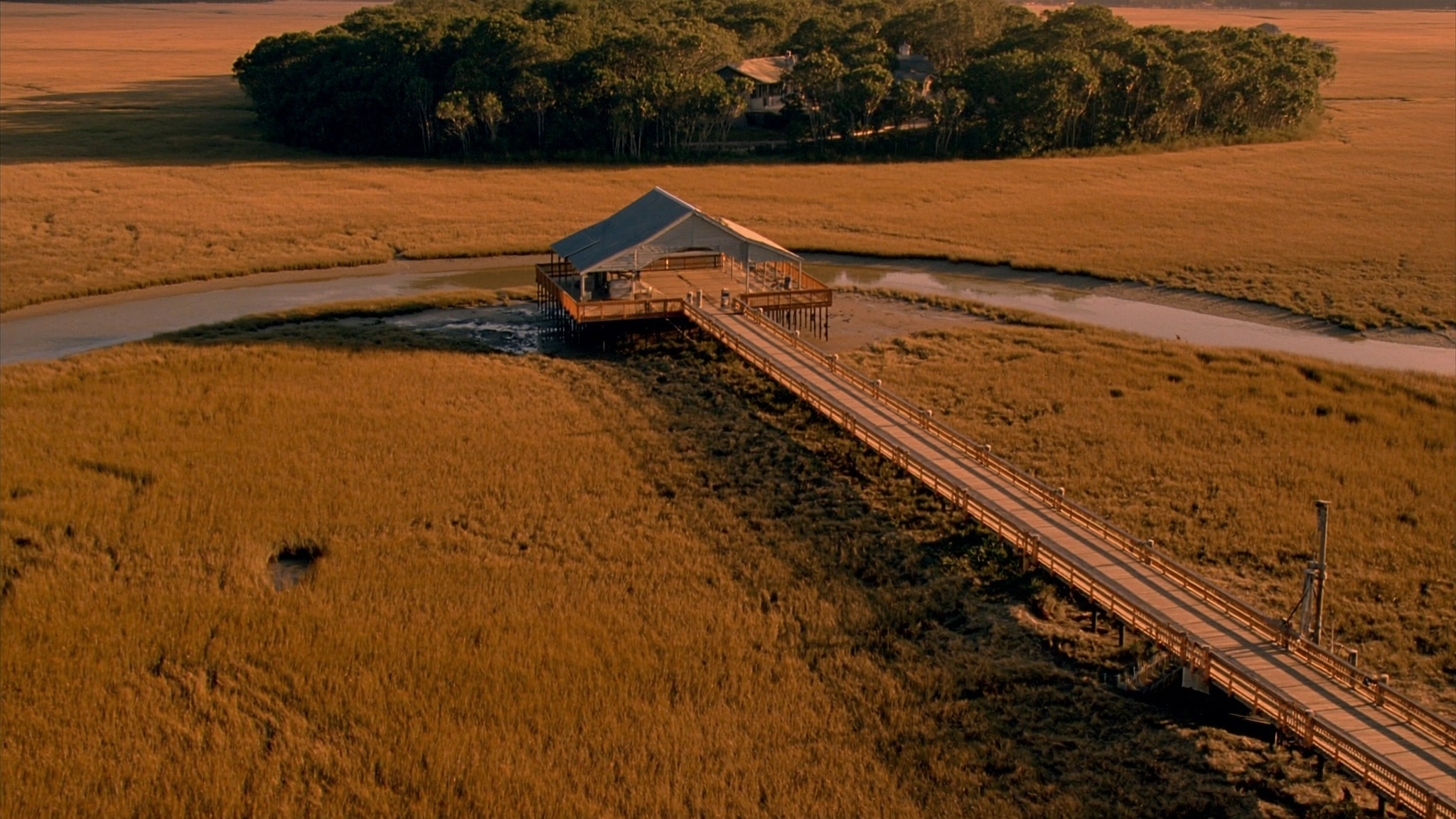
It is the first question almost everybody asks, and it is a fair one. You want a dock. You want to know what you are getting into before you spend a Saturday talking to contractors.
Here is the honest answer: nobody can give you a real number over the phone. Not us, not anybody. Two houses on the same creek, four lots apart, can be tens of thousands of dollars apart on the same dock. That is not a dodge. It is how waterfront works in the Lowcountry.
What we can do is show you exactly what moves the number, so when you get a quote you can read it instead of just reacting to the bottom line.
The single biggest driver: how far you have to walk
A dock in Charleston is mostly walkway. The pierhead at the end, the part you actually sit on, is often the smallest piece of the build.
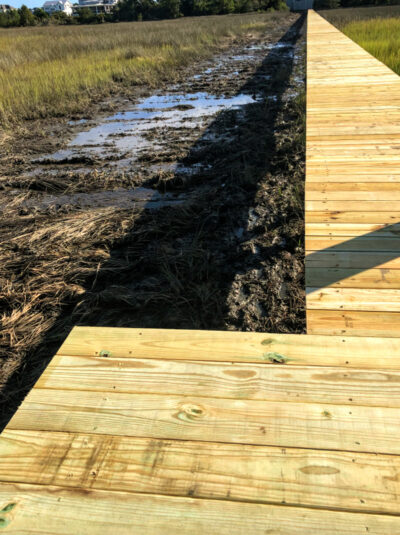
If your high ground ends and the creek starts thirty feet later, you are in good shape. If there is two hundred feet of spartina marsh between your lawn and water deep enough to float a boat at low tide, you are paying for two hundred feet of elevated structure. Every foot of that walkway needs pilings, framing, decking and fasteners, and every foot of it gets built over mud you cannot drive a truck across.
This is why the answer to “what does a dock cost” is really “how far is your water.” Walk your property line at dead low tide and look. That walk is most of your budget.
Pilings are the other half of the story
Every dock stands on pilings, and pilings are the part people underestimate. They are not posts you set in a hole. They are driven, and driving them takes a rig, a crew and often a barge.
How many you need depends on the span between them, the load the structure has to carry and what the bottom is made of. Some creek beds take a piling easily. Others hit hard strata, or worse, run soft far deeper than anybody expected, which means longer pilings and more time on site. We do not publish depths or spacing as advice, because getting that wrong is how docks end up leaning three years later. It gets determined on your site, for your conditions. But it is a real line item and it is a big one.
If you want to understand what separates a piling that lasts from one that does not, we wrote about that in pile driving done right.
Access changes everything
Can we get equipment to your shoreline from the land side? Or does the whole job have to come in by water on a barge, scheduled around the tide?
Barge work is not exotic here. Plenty of Charleston properties can only be built from the water, and we do it constantly. But it costs more, and it costs more in a way that is easy to miss when you are comparing two quotes. A barge crew works the tide window. When the water leaves, the day is over, whether the work is finished or not. That is real time on a real schedule.
Landscaping matters too. If there is a mature live oak, a bulkhead, an irrigation system or a neighbor’s fence between the road and the water, somebody is working around it carefully instead of quickly.
What you put on top
Once the structure is standing, the finishes are where you have the most control over the budget.
- Decking. Pressure-treated pine is the baseline. Hardwoods and composites cost more up front and behave differently in our sun and salt. We broke down the trade-offs in choosing the perfect decking material.
- Fasteners. Sounds trivial. Is not. The wrong screw in saltwater turns into a maintenance bill in year three. See stainless versus coated decking screws.
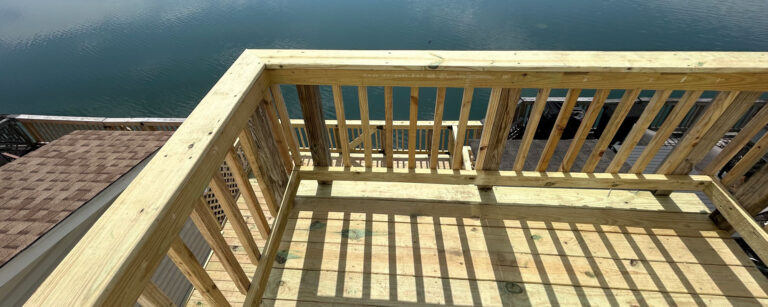
- Roof or no roof. A covered pierhead is a different structure, not a dock with a hat on it. It carries wind load and it needs to be engineered for it.
- Boat lift. Often the largest single add-on. Worth its own conversation, which we had in which boat lift fits your waterfront.
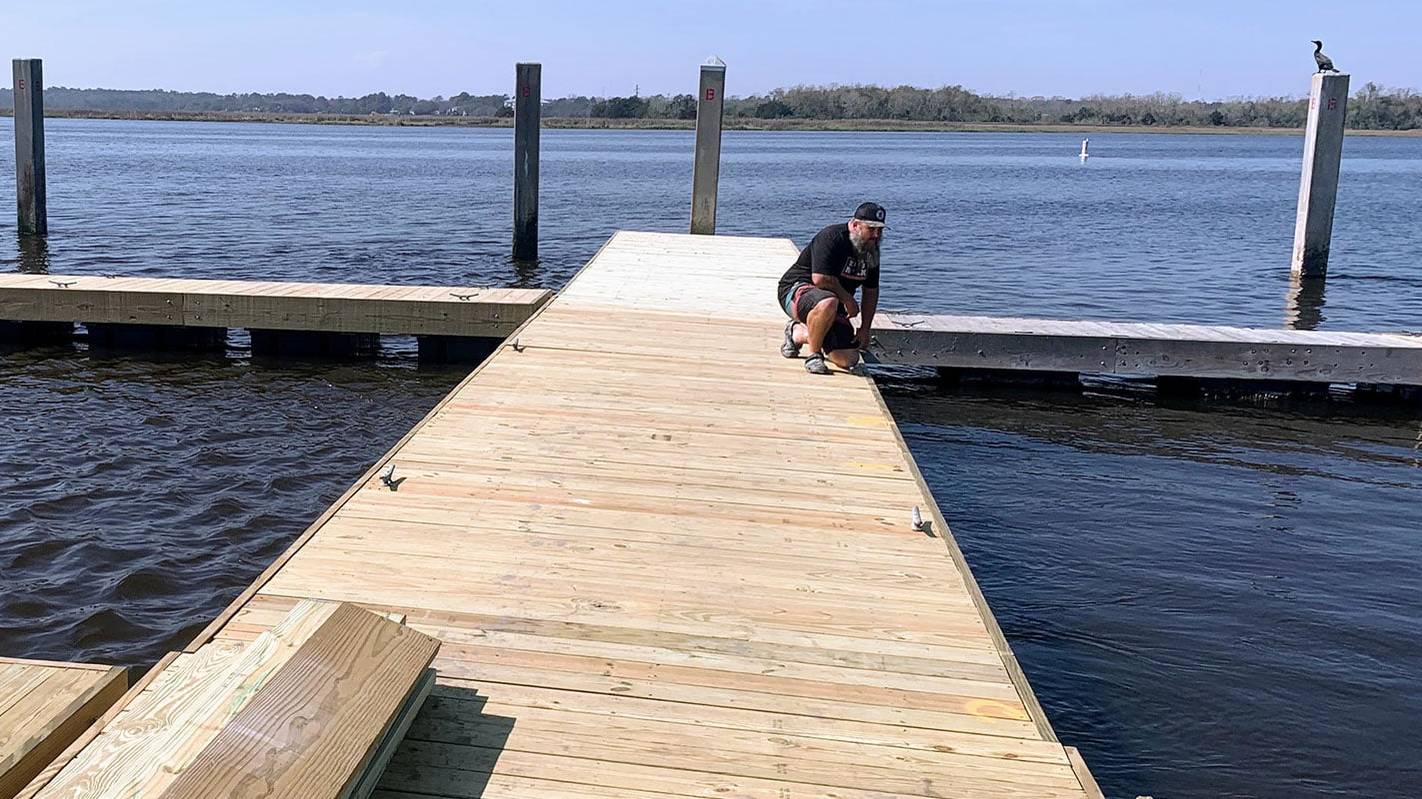
- Floating dock and ramp. If you want to step onto your boat at any tide, you need a float and a gangway. That is added structure and added hardware.
Permitting is time, and time is money
A new dock in South Carolina goes through SCDHEC-OCRM, and depending on the project, the Army Corps of Engineers as well. We will not promise you an approval or a date, because that is not in anybody’s control but the agencies’. What we will tell you is that permitting is the part of the project most likely to stretch, and the part most likely to change your design.
Budget for the review honestly. If you want to understand where the delays actually come from, read what slows dock permit approvals and the permitting gotchas we see most often.
Why a dock costs more than a deck of the same size
People compare dock quotes to backyard deck quotes and get a shock. The comparison does not hold. A deck sits on level ground, gets built from a driveway, needs no marine permit and never goes underwater. A dock does the opposite of all four. We laid out the full comparison in why docks cost so much more than decks.
How to read a dock quote
When you have two or three numbers in front of you, do not just compare the totals. Compare these:
- Is the walkway length the same in both quotes? If one is shorter, ask where it stops and what the tide is doing there.
- Are pilings itemized, with count and material stated?
- Are fasteners and hardware specified, or just “hardware”?
- Who is handling the permit application, and is that cost in or out?
- What happens if the bottom conditions differ from what was assumed? A quote with no answer to that question is not really a quote.
A low number that leaves out permitting, assumes easy driving and specifies nothing is not a bargain. It is a placeholder that will move.
Get someone on your property
The only way to price a dock is to stand on the site at low tide and look at the mud, the distance, the access and the neighbors. Everything else is a guess dressed up as a number.
We will come out, walk it with you, and tell you plainly what your property will and will not support. If a smaller dock gets you ninety percent of what you want for half the money, we will say so. And if you already have a proposal from someone else and just want a second set of eyes on it, we will read it with you.
See what we build on our new builds and installation page, or get in touch and we will get on the calendar.