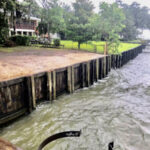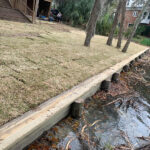
A seawall doesn’t just need strength out front.
It needs something holding it back.
That’s where tiebacks come in. On many lumber seawalls, bulkheads, pond walls, and retaining walls around Charleston, James Island, John’s Island, Mount Pleasant, Moncks Corner, and tidal creek properties, tiebacks are one of the quiet details that help a wall resist pressure from soil, water, and runoff.
Not glamorous, but important.
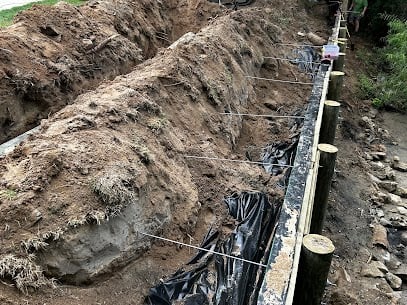
A tieback is typically an anchoring system that connects the wall back into more stable ground behind it. In many residential marine construction settings, that may involve galvanized all-thread rod running from the wall face back to an anchor point. The exact style depends on the wall, soil, access, height, water exposure, and what’s behind the wall.
At Charleston Dock Doctors LLC, we may recommend tiebacks for new seawall construction, bulkhead rebuilds, taller retaining walls, or existing walls that are starting to lean, bow, or show movement. They’re especially important when a wall is holding back significant backfill, dealing with regular water exposure from the front, or receiving a lot of runoff from the yard side.
Here’s the thing: water pressure doesn’t ask politely.
Tiebacks can be built several ways. Some residential walls use concrete anchor-style tiebacks, where the rod connects back to an anchor set in concrete. Some projects may use steel anchors. Larger or more demanding projects may call for soldier pile-style anchoring, where a second row of piles is set back from the wall and tied through with steel all-thread. Commercial or engineered walls may require more extensive anchoring details, including deadman-style elements.
That’s not something to guess at from the driveway.
Older walls sometimes have outdated cable-style tiebacks wrapped around piles. If you see those, especially on an older seawall or bulkhead, it’s worth having the wall reviewed. Over time, corrosion and decay can weaken older anchoring systems, and a wall that has lost its tieback support may begin pushing forward.
In some cases, tiebacks can be added to an existing wall. That may involve drilling through the wall and pile, extending the rod back into the yard, and creating a new anchor point. In other cases, especially where soldier piles or deeper structural corrections are needed, the work may be better suited for a larger wall repair or rebuild.
Saltwater finds every shortcut.
That’s why Charleston Dock Doctors LLC looks at the whole wall: piles, sheeting, top cap, wailers, tiebacks, drainage, backfill, weep holes, and runoff paths. The company’s website lists seawalls, pond walls, bulkheads, retaining walls, dock repairs, pier repairs, and waterfront maintenance as core services for Charleston-area properties. If your seawall is leaning, cracking, bowing, or losing soil behind it, contact Charleston Dock Doctors LLC at CharlestonDockDoctors.com for a practical site review and repair options built around the actual conditions.