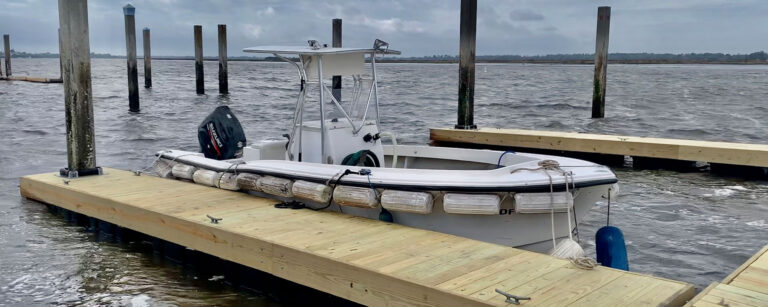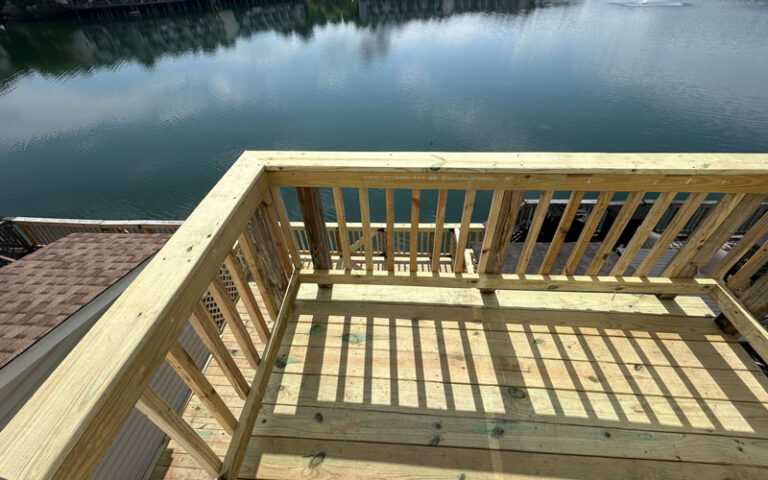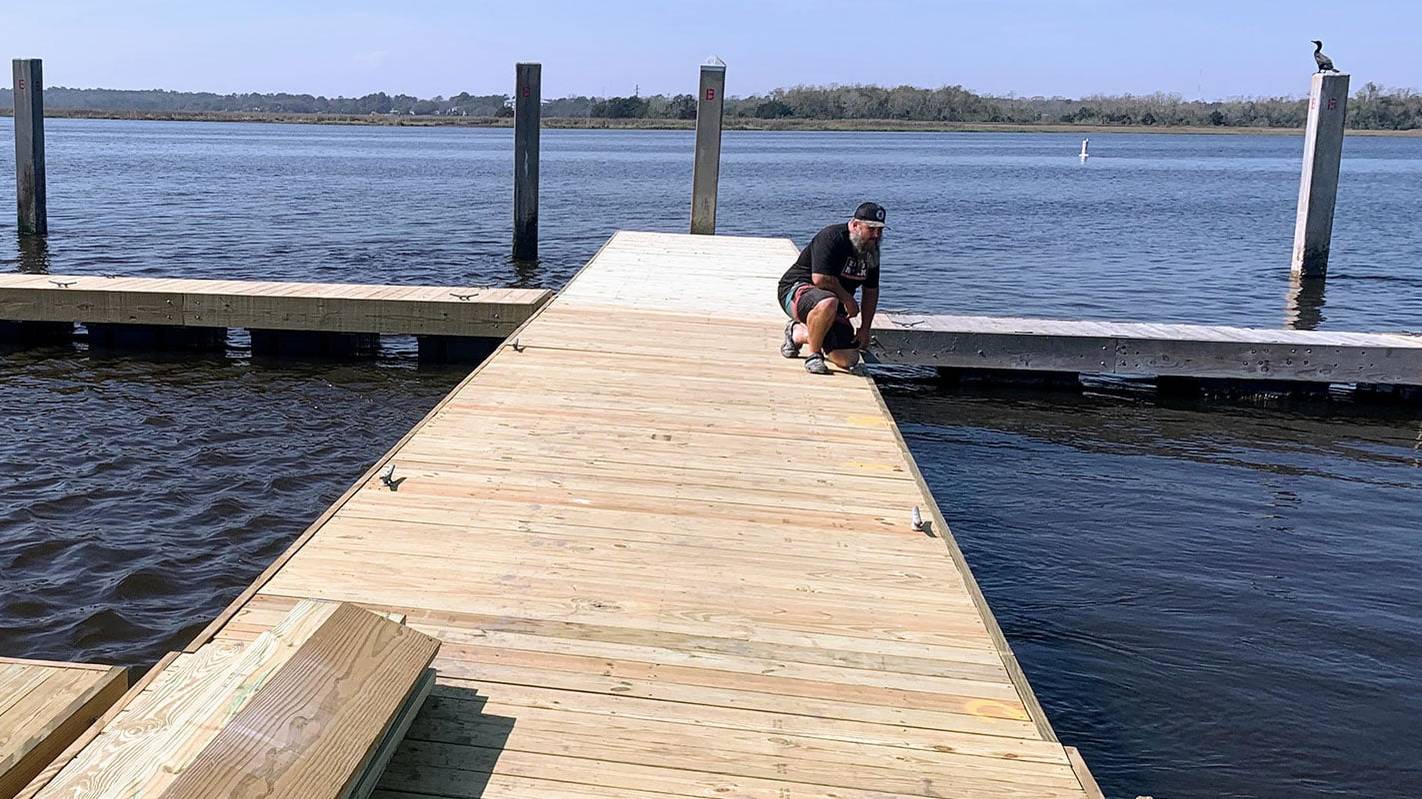
Power and water at the end of a dock are two separate runs doing two separate jobs, and both get settled before the first piling goes in. The setup most Charleston homeowners end up living with is usually one ground-fault-protected circuit off the house panel and one water line in the same trench, carried out under the walkway in conduit and brought up at the pierhead. None of it is complicated work. It is just expensive to add once the decking is screwed down.
The power and water Charleston dock owners actually use
Set the catalog aside and most private docks in the Lowcountry carry four things:
- A dedicated circuit, commonly 20 or 30 amps, run from the house panel rather than spliced off a garage or landscape circuit.
- One or two weatherproof outlets at the pierhead — the wide platform at the end of the walkway — in covers rated to stay shut with a cord plugged in.
- Lighting: post caps or step lights down the walkway, a flood on the pierhead, often a switch at both ends so nobody walks back in the dark.
- A hose bib, the outdoor spigot, for rinsing salt off gear, washing down decking, and feeding a fish-cleaning station.
Past that, everything is a specific want: a shore power pedestal for a boat kept in a slip, a dock box with its own outlet, a lift circuit, a speaker run. All of them are cheap to include on day one and awkward to chase later.
Conduit goes in before the decking
This is the part owners find out too late. The path for wire and pipe lives inside the dock structure: a trench from the panel out to the bulkhead or marsh edge, conduit sleeved through the walkway framing or strapped to the underside of it, blocking where a light post or pedestal will bolt down, and a stub left where the electrician lands the connection. That is all framing work, and it happens while the frame is open.
Add it afterward and the sequence runs backward. Decking comes off and gets numbered, conduit gets strapped under finished framing, a trench gets cut through an established yard, and a changed pierhead can mean a revised drawing for the permit file that the SCDES Bureau of Coastal Management and the U.S. Army Corps of Engineers, Charleston District already hold. Still doable. It just costs more and gets done twice. If you are mapping out the order of operations, how a Charleston dock build runs from the first call to the first piling shows where in that sequence the utility decisions get locked in.
Dock wiring has a code article of its own
A dock is not a deck, and the National Electrical Code (NFPA 70) treats it differently. Article 555 covers marinas, boatyards, and docking facilities, and it reads the way it does because current leaking into the water around a dock can incapacitate a swimmer — the hazard known as electric shock drowning. Ground-fault protection, which cuts power the moment current strays from the path it belongs in, sits at the center of that article.
The usual split on a job: a licensed electrician sizes the circuit, pulls the electrical permit, and makes the connections to whichever edition of the code the local jurisdiction has adopted. The dock builder owns the pathway — conduit sized with room to pull wire, junctions kept above deck level where they stay reachable, hardware set so nobody is improvising at the end. Getting both trades into the same conversation before the frame closes in is worth the phone call. Coordinating with a homeowner’s other contractors is routine for us; we have run a job alongside a pool contractor on a lakefront retaining wall and kept both scopes out of each other’s way.
Water lines and the freeze that comes once a winter
Charleston winters stay mild enough that people stop thinking about it, and then one January night drops below freezing and splits an exposed line on a pierhead. The protection is designed in rather than added: a shutoff valve on the landward side of the run, the line pitched so it drains back when that valve closes, the riser up the piling insulated or wrapped, and a vacuum breaker — a small backflow fitting — on the hose bib so dock water cannot siphon back toward the house.
Materials earn their keep in a salt marsh. Bronze and stainless hold up out there; plated hardware tends to be the first thing to go. Draining the line and working the shutoff belongs on the same cold-weather list as checking fasteners and decking, which is the routine laid out in our guide to seasonal dock and shoreline maintenance in Charleston.
A boat lift changes the power plan
If a lift is anywhere in the picture, build the electrical around it from the start. A lift motor wants its own circuit sized to the unit — the manufacturer’s spec sheet sets that number, not a rule of thumb — plus conduit out to the motor beam and a mounting spot for the control where a wet hand can reach it. Charleston Dock Doctors became an approved authorized Hurricane dealer in August 2026, covering sales, installation, and repair, so the lift and the dock it bolts to get drawn and scheduled as one job instead of two, with the electrician’s lift circuit planned in from the start.
Winter is when to decide
Marine construction runs on tide and weather windows, not on calendar convenience. A crew that needs low water to set a piling takes the tide it is given, and winter hands you longer stretches of workable weather between fronts than the back half of storm season does. Choosing in December what you want on the dock by May is how a job lands on time and within budget rather than waiting on a slot. If the dock is already standing and you are deciding between adding utilities and rebuilding, a walkthrough of the structure’s condition answers that question before you spend anything on wire.
Here is what a proposal ought to show before you sign it: the conduit route, outlet and light locations, the water line and its shutoff, and who is landing the connections. We furnish insurance certificates with the proposal. We will also read someone else’s proposal for you. HOA boards and private owners call us to gut-check a scope they have been handed, and a fair number of those calls end with the work going to the other contractor. That is fine by us. A thin utility plan on a new dock is harder to undo than a high number on a quote.
If a build or a rebuild is on the list for this year — floating docks and fingers, re-decking, pilings, a seawall, a lift — ask for the utility plan in writing at design stage, while the drawings are still cheap to change. Charleston Dock Doctors works the water from Awendaw and Moncks Corner down to Edisto Beach and Wadmalaw Island, nineteen Lowcountry communities in all, out of the shop on Elm Road in Charleston. Bring us your drawings, or look at every service listed on our sitemap to see what else belongs in the same contract.
Frequently asked questions
Do I need a permit to put in a dock?
Yes. Dock work in South Carolina’s tidal critical area is reviewed by the SCDES Bureau of Coastal Management, and the Army Corps runs its own review of structures in navigable water. Utilities are generally shown on the submitted plans rather than permitted separately, though the electrical hookup is its own local permit. Thresholds and forms change, so confirm current requirements with the permitting office before you finalize drawings. This is a general description of the process, not a legal opinion on your property.
Does dock water come off the house supply or a separate line?
On most waterfront homes it is a branch off the house supply, teed after the meter and run out in the same trench as the electrical conduit. If the property is on a well, the pressure and recovery rate need checking first, since a long run plus a hose bib at the end can pull down a system that is already working hard. Either way, the line gets its own shutoff on the landward side so the dock run can be isolated and drained.
What should happen to dock power before a storm?
Unplug cords from the pierhead outlets, shut the dock circuit off at the panel, and move anything loose off the deck, including dock boxes and lift remotes. After the water drops, look at the conduit and fittings before switching the circuit back on, since floating debris can pull hardware loose without leaving obvious damage above deck. If anything looks moved or the outlets have been underwater, have an electrician check it before use.
Can a dock have water without power?
Yes, and it is the simpler of the two to add. A water line and hose bib need a trench, a shutoff, and a backflow fitting, with no electrical permit or inspection involved. Plenty of owners start there and leave a spare conduit sleeve in the trench so the circuit can be pulled later without reopening the yard.