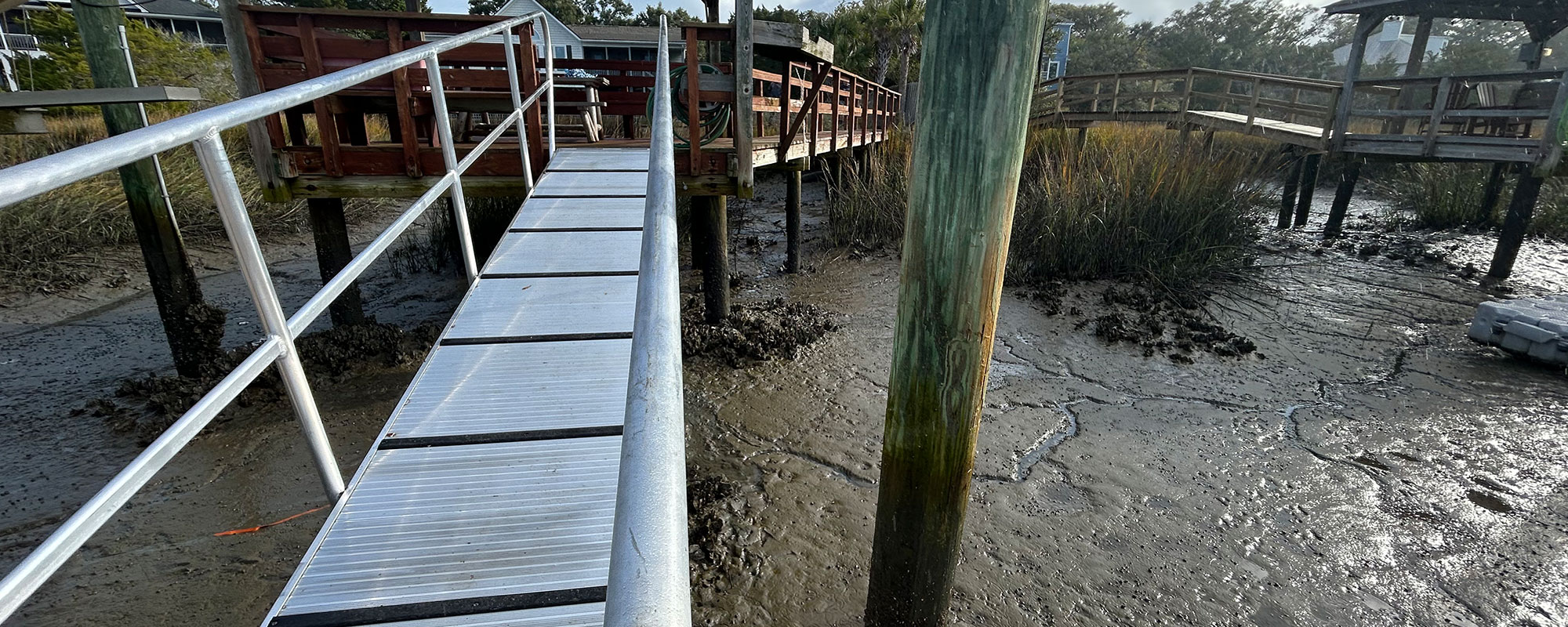
On a tidal creek, the gangway is the part of a floating dock you notice every single day. At high tide it is a gentle walk. At dead low it can turn into a ramp you would rather not carry a cooler down. Whether your dock is pleasant to use comes down to gangway length, how it is hinged, and what it is made of.
Why the tide makes it tricky
The float rises and falls with the water; the pierhead or bank it connects to does not. Around Charleston the water swings roughly five to six feet between low and high tide on an ordinary day, and more on spring and king tides. The gangway has to bridge that difference all day long.
Length sets the slope
The math is simple. The steeper the drop from the pierhead to the float, and the shorter the gangway, the steeper the walk.
Here is an example. If the float sits six feet below the pierhead at low tide:
- A 20-foot gangway runs at about 17 degrees.
- A 30-foot gangway runs at about 11.5 degrees.
- A 40-foot gangway runs at under 9 degrees.
Longer is gentler, but longer also costs more, weighs more and needs room on the float and pierhead. We size gangways to your actual low-tide drop, how you use the dock, and who uses it. If older family members or kids will be on it, err long. Public and commercial docks may have accessibility requirements that call for a much gentler slope.
The two ends matter
- The hinge end. At the pierhead, the gangway pivots on a hinge. It has to be strong, corrosion resistant and properly anchored into a structure that can carry the load.
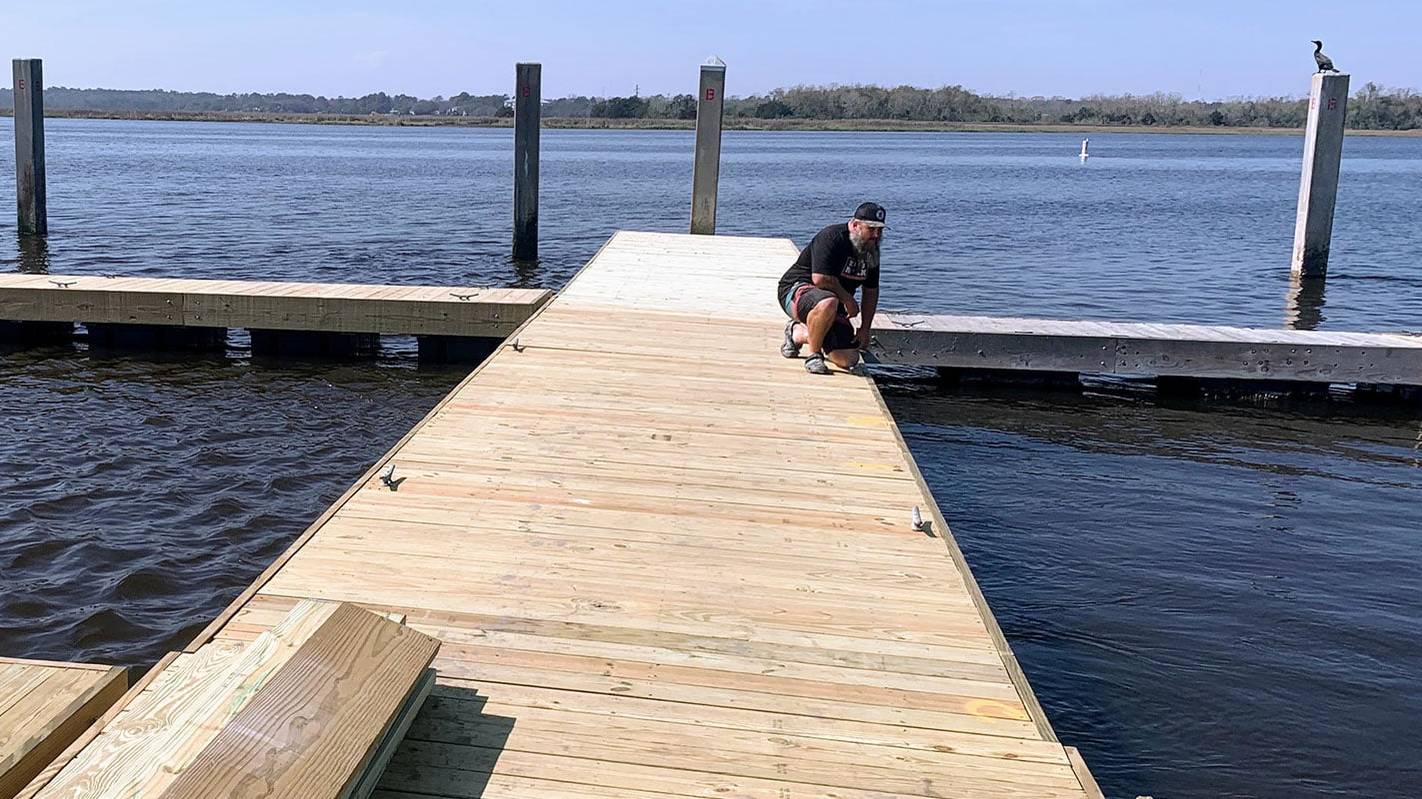
- The float end. At the float, the gangway slides as the tide moves. Rollers or a slide plate let it travel without gouging the deck, and a transition plate smooths the step on and off.
When either end wears out, the gangway starts to bind, bang or tear up the decking. Those are common repair calls. See dock repair.
Aluminum or wood?
Aluminum gangways are light, resist corrosion and usually come with non-skid treads and handrails. Lighter means less load on the pierhead and float and easier movement with the tide.
Wood gangways can match the rest of the dock and are easy to repair, but they are heavier and need more attention at the hinge and rollers. Composite decking on a gangway is another option, and some owners choose it to match the float. See decking materials for a Charleston waterfront.
Handrails and traction
At any real slope, you want handrails on both sides and treads that grip when wet. Algae and pollen make a sloped deck slick fast. Cleats or non-skid treads are worth it.
Before you add or replace a gangway
- Measure the drop at low tide, not when you happen to visit.
- Check that the pierhead can carry the hinge load.
- Make sure the float has room and buoyancy for the gangway’s landing.
- Plan handrails and lighting together. See dock power, water and lighting.
If you are still choosing a dock type, read floating dock vs. fixed pier and what drives floating dock cost.
Get a gangway that works at low tide
Charleston Dock Doctors builds and repairs floating docks, gangways and boarding fingers across the Charleston area. Request a quote or call 843-224-2653.