Anyone who has tried to get into a kayak from a fixed dock at low tide knows the problem. The boat is three feet below you, it moves when you touch it, and there is nothing to hold on to. A kayak launch fixes that. Done right, you sit down in the boat while it is still on the dock and slide into the water dry.
Here is how launches work on a tidal Charleston dock and what to think about before you add one.
Why tidal water changes the answer
On a lake, the water stays put. Around Charleston, the water level swings roughly five to six feet between low and high tide on an ordinary day, and more on spring and king tides. A launch fixed to a pier works at one water level and is useless at the others.
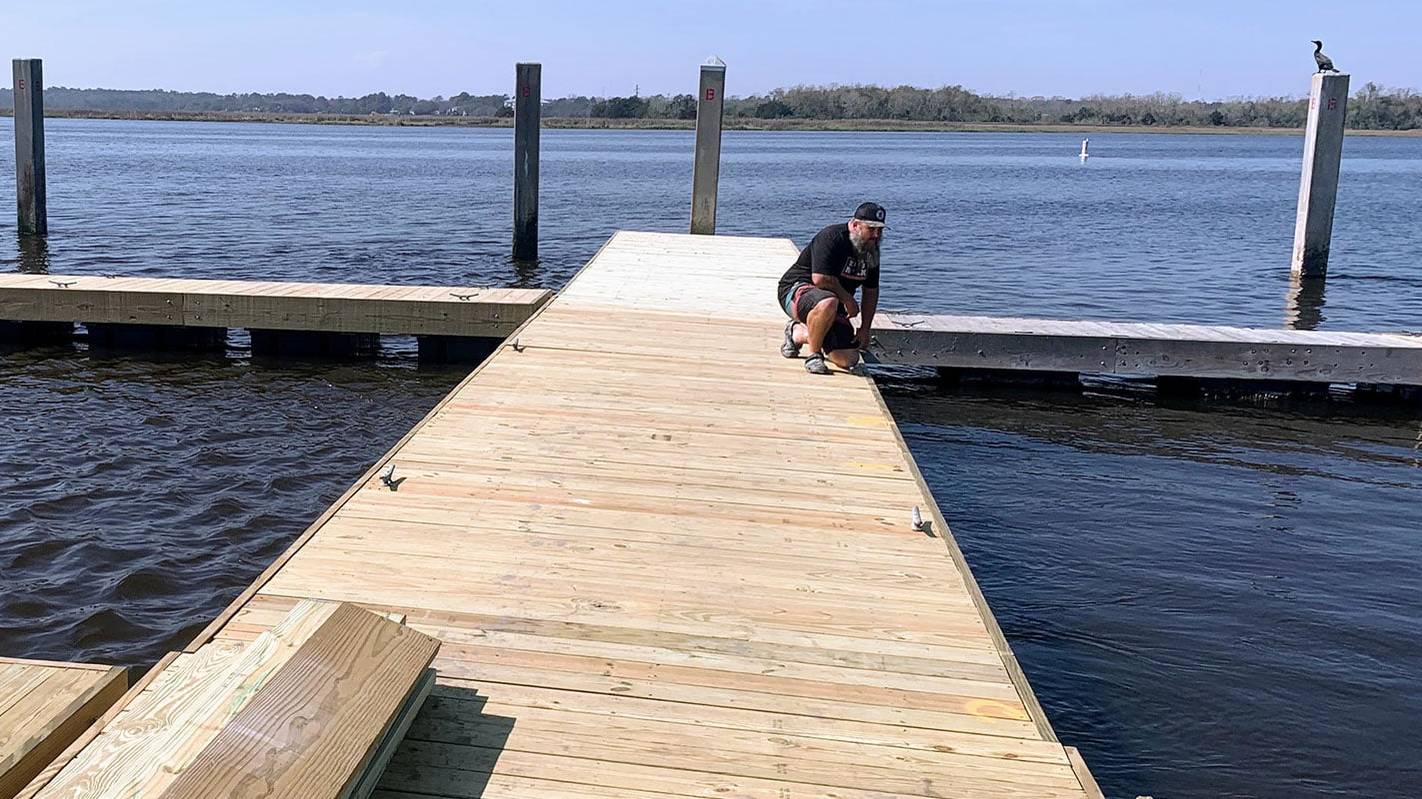
That is why most kayak launches here go on a floating dock. The float rises and falls with the tide, so the launch sits at the same height above the water all day.
The main types
Slide-in launches
The kayak sits in a cradle or on guide rails at water level. You get in while it is supported, then push off and slide out. Getting back is the reverse: paddle in, the guides center the boat, and you climb out onto the float. These are the most common choice for kayaks.
Roller launches
Rollers along the guides make it easier to slide a heavier boat in and out. They are useful for fishing kayaks loaded with gear, or for anyone who would rather not drag.
Low platforms
A low step-down platform built into the float works well for paddleboards and for people who prefer to step onto a board rather than sit and slide. It also doubles as a swim step.
Where to put it
- On the side of the float away from the boat slip, so a kayak and a boat are not competing for the same space.
- Out of the main current, which makes launching and landing calmer.
- Where the float has enough freeboard and buoyancy to carry the launch and a person getting in or out of a boat on it.
Storage matters as much as launching
Half the reason people want a launch is so they stop carrying boats up and down the walkway. Plan where kayaks and boards will live: on racks on the float, on the launch itself, or on a lift. Keeping them off the deck means fewer stubbed toes and less sun damage.
Can one be added to my existing dock?
Often, yes. If you already have a floating dock in good shape, a launch can usually be added. If you have only a fixed pier, the launch will need a float and gangway, which is a bigger project but often worth it. See floating dock vs. fixed pier and what drives floating dock cost.
Permits
A launch added to an existing permitted float is usually straightforward. If it adds a float or changes the dock footprint, it may need approval. We can guide you through the process.
Get on the water easier
Charleston Dock Doctors builds custom kayak and paddleboard launches and installs boat lifts across the Charleston area, so you can leave it where you park it. Request a quote or call 843-224-2653.