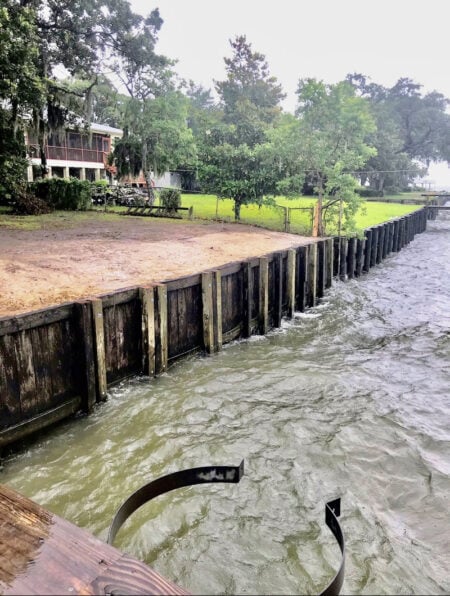
Erosion doesn’t just take dirt.
Sometimes, it changes what you’re allowed to do next.
Along Charleston creeks, ponds, marsh edges, and riverfront lots, the critical line matters. If the yard keeps washing away and a new survey or site review shows the wetland edge has moved landward, that can affect usable yard space, future seawall or bulkhead planning, and how far a dock or pier may need to extend to reach usable water.
Here’s the thing: the water always tells on bad timing.
When erosion gets ignored, the shoreline can move closer to trees, landscaping, fences, pools, patios, and home sites. In some cases, nearby large trees may create added design constraints. A wall that could have been a fairly straight run may need to jog around sensitive areas, existing trees, drainage features, or regulated buffers. More turns usually mean more linear footage, more materials, and more planning.
That’s why Charleston Dock Doctors LLC encourages waterfront owners to pay attention early.
The first signs are usually simple: exposed roots, sinking yard edges, soil washing out after rain, marsh grass creeping farther into the lawn, or a pond bank becoming steeper each season. Around Charleston, James Island, John’s Island, Mount Pleasant, Wadmalaw, and the Wando or Stono River, that can happen faster than homeowners expect.
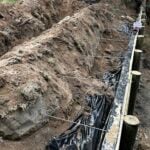
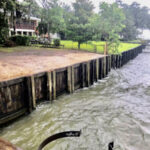
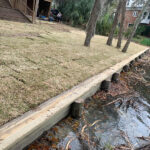
A properly planned seawall, bulkhead, retaining wall, or rip rap solution may help stabilize the edge before the problem pushes farther into the property. The right option depends on the site. Some yards need a lumber wall. Some need vinyl wall. Some need rip rap. Some need drainage work behind the wall so trapped water doesn’t keep pushing soil out from the back side.
Drainage is a big one. Weep holes, filter fabric, #57 gravel, French drain-style improvements, and proper discharge paths can make a major difference when a wall is dealing with water from both sides. Saltwater on one side. Rainwater and runoff on the other.
Small detail. Big difference.
Erosion can also affect dock and pier design. If the protected or wet area shifts landward, a pier may need to be longer to cross sensitive ground properly and reach the right access point. That can change pile layout, headers, stringers, decking, handrails, and overall project scope.
Charleston Dock Doctors LLC builds and repairs seawalls, bulkheads, piers, pierheads, docks, retaining walls, and waterfront access structures throughout the Charleston area. The company’s website lists seawalls, pond walls, bulkheads, elevated piers, pierheads, boardwalks, maintenance, and repairs as key services for local waterfront properties.
If you’re seeing shoreline loss, don’t wait until the yard tells the whole story. Contact Charleston Dock Doctors LLC at CharlestonDockDoctors.com for a site visit and practical options to protect your waterfront.
Call Us : +1 843-224-2653
Mon – Fri: 7 am to 6 pm & Sat 9 am to 3 pm